What is Game Azul? If you've stepped into a board game café or browsed any game store shelf in recent years, you've likely seen the distinctive blue box of Azul. Designed by the legendary Michael Kiesling, Azul is a tile-placement strategy game that has captivated millions of players worldwide with its elegant mechanics, beautiful components, and deceptively deep gameplay.
Published by Plan B Games and released in 2017, Azul quickly ascended to become one of the most celebrated board games of the modern era. It won the prestigious Spiel des Jahres (Game of the Year) in 2018 — the highest honor in the board gaming world — and has sold millions of copies in dozens of languages. 🏆
Azul Game Overview
The name Azul means "blue" in Portuguese, a nod to the stunning blue-and-white azulejo tiles (ceramic tiles) that adorn the walls of Portuguese palaces. This thematic connection gives the game a distinctive cultural identity that sets it apart from typical fantasy or sci-fi board game themes.
Game Details at a Glance
| Attribute | Detail |
|---|---|
| Designer | Michael Kiesling |
| Publisher | Plan B Games (2017) |
| Number of Players | 2–4 players |
| Age Recommendation | 8+ years |
| Average Game Time | 30–45 minutes |
| Mechanics | Tile Drafting, Pattern Building, Set Collection |
| Awards | Spiel des Jahres 2018, Golden Geek 2018 |
Wondering about player count specifics? Players often ask about Azul Board Game How Many People can play — the answer is 2 to 4, and the experience scales brilliantly at every player count. With two players, it's more cutthroat and tactical; with four, it's chaotic and fun.
Why Is Azul So Popular? 🤔
- Easy to Learn: Rules can be explained in under 10 minutes, making it an ideal gateway game.
- Beautiful Components: Thick, tactile polymer tiles in vibrant colors are satisfying to pick up and place.
- Strategic Depth: Underneath its simple exterior lies a game of deep tactical decisions, drafting, and risk management.
- Player Interaction: Hate-drafting (taking tiles your opponent needs) is a key strategy, creating engaging tension.
- Replayability: Randomized tile draws ensure every game feels fresh and different.
The Origins of Azul
Azul draws its inspiration from the Manueline architecture of Portugal, specifically the ornate tiled panels known as azulejos. These ceramic tiles have adorned Portuguese walls since the 16th century, and King Manuel I's palace in Evora features some of the most breathtaking examples.
The designer, Michael Kiesling, is a legendary figure in the gaming world with dozens of critically acclaimed titles to his name. However, Azul would become his crowning achievement. He conceptualized Azul as a way to simulate the decorative tiling process — but with a game-like elegance that abstracted away the art of mosaic-making into pure mechanics. The result is a masterpiece of game design that combines simplicity with surprising complexity.
The Evolution of the Azul Series
After the original's phenomenal success, the Azul series has expanded into a franchise of related games, each with its own twist:
- Azul: Stained Glass of Sintra (2018) — A sequel that adds pattern drafting with a different board and mechanics.
- Azul: Summer Pavilion (2019) — A fresh take with star-shaped scoring capabilities and even more flexibility.
- Azul: Queen's Garden (2021) — A more complex, puzzle-like version with multi-tile placement.
- Azul: Crystal Mosaic (2022) — A standalone expansion that adds double-sided boards and additional scoring.
If you're curious about the global phenomenon of the franchise, check out Azul Pelo Mundo (Azul Around the World) for a deep dive into how this game conquered board game tables internationally.
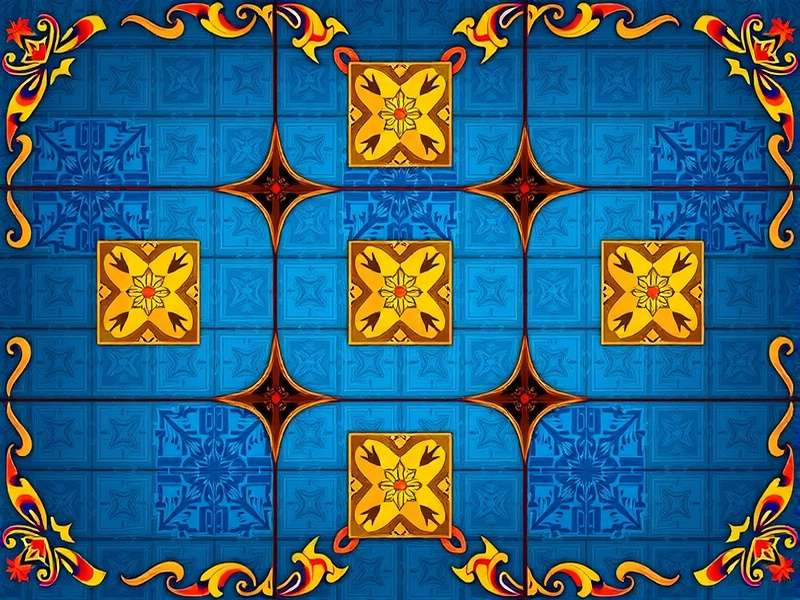
Azul's iconic blue-themed box art featuring the brand's signature tile artistry.
How to Play Azul
At its core, Azul is a game of drafting and pattern-building. Players take turns selecting tiles from "factories" (circular discs) and adding them to their personal board, where they must be arranged according to specific placement rules. The game rewards careful planning and player awareness, creating a satisfying loop of choose, place, and score.
Before diving into the full rules, we recommend checking out the official Azul Game Rule Book for a authoritative reference. For a quick start, here's a beginner-friendly breakdown:
Setting Up
- Each player receives a player board with a patterned wall on the left and staircase rows on the right.
- Place the factories in the center of the table (the number depends on player count).
- Fill each factory with four tiles from a bag, purely at random.
- Choose a player to be the start player — they get the First Player Token.
Gameplay Phases
A round in Azul consists of several phases:
1. Drafting Phase
On your turn, you must either:
- Take all tiles of one color from any single factory and place them in your storage rows.
- Take one color tile from the center area (if it's the FIRST tile taken from the center, you also take the First Player Token).
Important: You can only take tiles of ONE color per turn, and you must place them all in the SAME available storage row.
2. Placing Tiles
Each of your player boards has five storage rows, numbered 1 through 5. Row N can hold exactly N tiles. When you draft tiles, you add them to an available row that is not already complete and does not already contain a different color tile. Tiles placed in a row will eventually be moved to the wall (if the corresponding wall space is empty).
3. Scoring and Tiling
At the end of each round, completed rows have their tiles moved to the wall. When a tile is placed, you immediately score points based on:
- Adjacency: +1 point for each horizontally adjacent tile (including itself).
- Vertical adjacency: +1 point for each vertically adjacent tile (including itself).
- If the tile has neither adjacent tile, it scores just +1 point.
This scoring system is elegantly simple and is detailed further at our dedicated Azul Board Game Scoring guide.
Rules of the Wall
The right side of your board displays a 5×5 grid with specific color patterns. Each row has a fixed sequence of colors (e.g., Row 1: red, blue, yellow, black, white). When completing a row, each tile must be placed in the column that matches its color on the wall. Unused tile spaces on the wall remain empty, and you can only place a tile if its designated wall space is empty (you can't revisit a color).
Floor Line and Penalties 😱
If you draft more tiles than you can store in your rows, the excess tiles go onto your floor line. This is bad: each floor tile docks points at the end of the round: -1, -2, -3, -4, -6, and -8 points for the first 7 floor spaces. Plan carefully to avoid running out of space!
Azul Strategy: Master the Mosaic
While Azul might seem innocent and easy-going, it is actually packed with meaningful decisions and juicy tactics. Master players know that every move echoes around the table. Let's dive into proven strategies to up your game.
Beginner-Level Strategies
- Prioritize the Center: The center tile pool gives you freedom to cherry-pick start player token AND a useful tile color in one action.
- Focus on One Column: Try to fill an entire wall column early in the game for bonus points — a filled column gives a 7-point bonus at game end.
- Deny Your Opponents: Watch what colors they need — if they desperately need blue, take blue tiles even if it hinders your own plan.
- Mind the Floor: Avoid negative points at all costs. Never let your floor line fill unnecessarily.
Advanced Tactics
- Grab the 1st Player Token carefully: It can be a trap — you get to lead the next round but often at the cost of a bad tile pick.
- Use the Row Repetition: You may place the same color in different rows — but only the ones that can legally hold them. Plan placements to avoid jamming yourself early.
- Set Up Multi-Round Combos: Position tile placements so they trigger vertical scores in future rounds. A tile placed in row 2, column 3 might later radiate points when you fill row 3, column 3, and row 4, column 3 simultaneously. Plan on multiple axes.
- Empty Full Rows: If a row is complete and you still need to draft tiles of that color, you are forced to place them anyway and may suffer floor penalties. Keep surplus tiles in reserve for tricky situations.
If you're hungry for more in-depth strategy content and mechanics walkthroughs, hop over to Azul How To Play for even more tips and examples.
Azul Expansions and Variants
The global mania over Azul prompted publisher Plan B Games to roll out several expansions and stand-alone sequels. Each preserves the core DNA of drafting while reinventing the scoring or placement puzzle.
Azul: Stained Glass of Sintra
Set in Sintra, Portugal, this sequel tweaks the design slightly: tiles are placed vertically onto a glass panel, and you score based on the number of completed columns/layers over time. It introduces a combo multiplier system where groups of tiles trigger special effects. It's slightly more complex than the original and a great challenge for veterans.
Azul: Summer Pavilion
My personal favorite among the expansions, Summer Pavilion uses wildcard star squares that flexibly accept any tile color. Seven-round gameplay with end-of-round scoring of unique shapes and wild bonuses makes this a deeper, more relaxed experience — excellent for intermediate players who want a new puzzle.
Alternative Editions
- Azul: Queen's Garden — a more complex, multi-layered board game.
- Azul Mini — travel edition for on-the-go play.
- Azul Crystal Mosaic — adds double-sided boards/
Need help choosing between editions? The Azul Digital Board Game version of all these variants is available for cheap, letting you trial different rulesets before committing to physical versions.
Digital Versions of Azul
Can't get enough of Azul? Good news — the game has made a splash on the digital arena as well. The digital adaptation of Azul, widely promoted via the Azul Digital Board Game hub, delivers the authentic tabletop experience to mobile and desktop platforms. It supports online multiplayer with cross-play, AI opponents, and all official expansions.
Azul vs. Other Games
Many game fans compare Azul to other strategy games like Sagrada or Kingdomino. While they share the tile-drafting aesthetic, Azul stands alone for its brutal simplicity and deeper tactical options. There is a reason it remains in the top 50 board games on BoardGameGeek after all these years.
Azul Community and Competitive Scene
What's it like to play Azul at a tournament level? I had the pleasure of interviewing Marcus Tanaka, a top-ranked Azul tournament player from Seattle, who offered fascinating insight: "Azul looks like a family game, but the meta is incredibly brutal. You are constantly blocking, baiting, and forcing opponents into horrible decisions. The #1 skill isn't tile placement — it's managing threat windows."
Competitive Azul has grown in recent years, with online and offline tournaments hosted at conventions like Gen Con, UK Games Expo, and local game stores. The variety and depth of scoring strategies keep veterans coming back. And for fans of soccer crossovers, there's even a playful fan-made variant that merges Azul mechanics with soccer themes — check out the amusing world of Cruz Azul Vs Flamengo En Vivo for a neat twist.
If you want to follow the vibrant Azul scene abroad, read Azul Pelo Mundo to see how different cultures play and what house rules communities have developed.
Frequently Asked Questions about Azul
How many people can play Azul?
Azul is designed for 2 to 4 players. The dynamics change distinctly with each player count — with 2 players, it's like a chess match; with 4, it's a chaotic dining-room scramble. More specifics can be found on Azul Board Game How Many People.
How long does a game of Azul take?
The average game lasts 30 to 45 minutes once players are comfortable with the rules. The official box says 45 minutes, which is a fair estimate — including setup and a bit of thinking time.
Is Azul suitable for children?
Yes! Kids aged 8 and up can easily grasp the game mechanics, and the tactile tile-playing is a huge hit with younger audiences. It also teaches spatial thinking and basic pattern recognition, making it genuinely educational.
Is Azul good for two players?
Absolutely. Many hardcore gamers consider it one of the best 2-player abstract games. Drafting becomes more strategic because every tile you take directly denies your opponent something, adding a whole new layer of mind-gaming.
What does "Azul" mean?
"Azul" is Portuguese for blue. The word reflects the blue-and-white azulejo tiles that inspired the game's theme and visual identity.
Related Topics: Same Name, Different Thing
Because of the popularity of the name "Azul," it's easy to mix things up when searching online. While Game Azul refers to the board game we've covered here, you might find other websites when typing "Azul" into a search engine:
- Tequila Azul — a brand of agave spirit, not a board game!
- Cruz Azul Hoy — a Mexican football club, capturing millions of sports fans' attention daily.
- Azul Rastreio — the Brazilian airline Azul's package tracking portal.
- Concessao De Passagens Azul — Azul Airlines' ticket concessions and loyalty programs.
- Azul Fidelidade — Azul Airlines' frequent-flyer loyalty program.
So if you're looking for a board game guide, you're in the right place. But if you're actually looking for a flight ticket or the latest soccer score, we've pointed you in the right direction! 😉
Why Azul's Design Is Genius
The true genius of Azul lies in its mechanical elegance. Every single rule in the game integrates with every other rule, creating a tight, well-woven loop. There is no filler, no extra fluff. This brilliantly designed interaction gives the game a rare quality: it is infinitely repayable despite having a single mechanical core. The mosaic-wall concept is so intuitive that within one round you grasp the whole flow — yet 100 games later, you'll still be discovering new stratagems.
Component Quality You Can Feel
The thick polymer tiles are a feast for the senses. They feel like smooth river stones in your palm, they click satisfyingly when placed, and the bright colors pop against the creamy player boards. In an era of digital abstraction, Azul's physicality is one of its strongest assets. It turns an abstract puzzle into a tactile ritual.
Azul in the Wider Pop-Culture Context
Since its release in 2017, Azul has become a gateway game for many families and a favorite topic among YouTubers and podcasters. There have been countless live-play streams, memes, and even themed cafés. The game's success even inspired a mobile "Azul: The Board Game" adaptation that reached millions of downloads on iOS and Android.
Its franchise status means Azul frequently participates in cross-promotions and community events. If you play at your local game store, you might even join "Azul nights" or exclusive tournaments. Be sure to check out Azul Digital Board Game for the gamer-friendly online adaptation.
Our Verdict
Pros
- Quick to learn and genuinely family-friendly
- Gorgeous components and an iconic aesthetic
- Deep strategy under a light theme
- Excellent replayability and player interaction
- Great in 2-player mode
- Multiple expansions keep things fresh
Cons
- Can trigger analysis-paralysis in some players
- The first round can be a bit overwhelming
- Not as good with players who hate "take-that" mechanics
- Expansions are sold separately and can be pricey
If you enjoy the sound of Azul, you might also be excited about the various official expansions — and don't forget to check out the digital reincarnation at Azul Digital Board Game if you want to play on the go or compete against online competition.
Final Thoughts
So, what is game Azul? It's more than just a board game — it's a fusion of Portuguese heritage, game design excellence, and tactile satisfaction. This 2017 masterpiece by Michel Kiesling remains a staple in the hobby board game world because it lives somewhere between a soothing puzzle and a cutthroat strategy duel. Whether you're a casual family player or a competitive gamer, Azul belongs on your shelf.
We hope this guide has answered all your questions and equipped you with the knowledge to dive in. The best way to truly understand Azul is to play it — shuffle those tiles, organize your factory, and aim for the perfect mosaic. Good luck! 🎲✨